


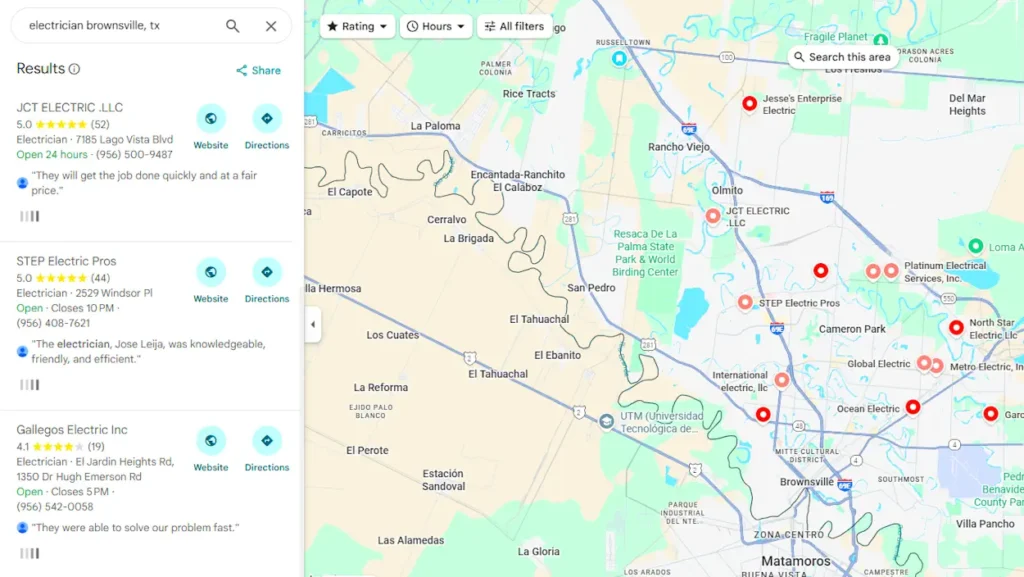
If you own a local business like an electrician in Brownsville, a plumbing service in Pharr, or a boutique shop in Harlingen, you want to show up when nearby customers are searching for what you offer. This is what local search is all about. It’s what happens when someone searches for “coffee shops near me” or “plumber in McAllen.”
What Is Local Search and Why Does It Matter for My Business?
It matters because these searches are often followed by immediate action. A high ranking means more calls, more foot traffic, and more sales for your business. When you appear in the top results, you grab the customers who are ready to buy right now.
According to Google, 76% of people who search for something nearby on their smartphone visit a related business within a day.
Ignoring the question what is local search optimization is like having a beautiful storefront on a street that no one walks down. We’ll show you the simple things you can do to put your business in front of local customers.
How Do Search Engines Decide Who Ranks Highest?
Search engines like Google use three main factors to figure out which businesses to show when someone searches locally. Think of these as the three pillars of local search ranking. Understanding these pillars will help you focus your efforts for the best results.
Proximity: How Close Are You to the Searcher?
The first and most obvious factor is location. If someone is searching for a dentist, they usually don’t want to drive an hour away. The search engine checks how close your business’s address is to the person doing the searching.
The closer you are, the better your chances are of being shown. This is especially true for searches that include the words “near me.” You can’t change your physical location, but you can make sure your address is 100% correct everywhere online.
Voice searches through phones and smart devices are the most location-sensitive queries of all. When someone asks their phone to find a plumber, Google uses their exact GPS location in real time — proximity is the dominant factor.
Relevance: Does Your Business Match the Search?
Does your business actually provide the service or product the customer is looking for? Search engines look at your website and your Google Business Profile to understand what you do.
For example, if someone searches for “dog groomer,” a search engine will prioritize businesses that clearly state they offer dog grooming services. You need to use the right words that customers are searching for.
Beyond categories, your GBP service descriptions now feed directly into Google’s relevance matching. A service listed as “AC Repair” with no description is less relevant to the algorithm than one that reads “Emergency AC Repair and Installation — serving McAllen, Edinburg, and Mission.”
Fill every service field completely. Make sure your business categories and services are clearly defined and accurate.
Prominence: How Well-Known and Trusted Is Your Business?
Prominence is a search engine’s way of gauging how popular, well-regarded, and reliable your brand is. It’s a measure of your overall online authority and reputation. A prominent business is one that people trust and talk about.
Several things affect your prominence:
- Online Reviews: The number of reviews you have and, more importantly, your average star rating are huge. More positive reviews tell search engines you offer a great customer experience.
Consistently responding to reviews, positive and negative, signals to Google that your business is active and engaged. This response activity now contributes to your Prominence score.- Links to Your Website: When other reputable local websites (like a local newspaper or a Chamber of Commerce) link to your website, it signals trust to the search engine.
- Online Mentions: If your business is mentioned across the web in various places, even without a link, it shows that you are an established, active company.
What Can I Do to Improve My Local Ranking Today?
Improving your standing in local search results doesn’t require a huge budget, just some dedicated effort. Start with these simple, high-impact steps.
- Claim and Optimize Your Google Business Profile (GBP): This is the single most important step. Make sure your business name, address, and phone number, known as NAP, are exact and up-to-date. Choose the most relevant business categories and write a detailed description.
Write a GBP description that puts your most important keywords and city name in the first 250 characters — that’s what searchers see before clicking ‘more.’ - Gather More Positive Customer Reviews: Make it a standard practice to ask happy customers for a review. Respond to all reviews—good and bad—professionally and promptly. This shows you care and improves your overall prominence.
- Ensure Consistency of Business Information: Your business name, address, and phone number must be identical on your website, your GBP, and all other online directories (Yelp, Yellow Pages, etc.). Even slight variations (like “St.” vs. “Street”) can confuse search engines.
- Use Local Keywords on Your Website: Naturally include the name of your city, neighborhood, or service area on your website’s pages. For example, instead of just “Best Plumber,” use “Best Plumber in Pharr.” This helps show your relevance for local search queries. Part of the efforts of on-page SEO is to insure that each page is optimized to rank well for one keyword phrase. Using as many necessary pages to satisfy the specific keywords for your industry.
- Post to Your GBP Regularly: Publishing weekly updates, offers, or event posts to your Google Business Profile shows Google your business is active. Inactive profiles, ones with no posts in 90+ days, see reduced visibility in some markets.
By focusing on these four steps, you are directly addressing the three core ranking factors: Proximity (correct NAP), Relevance (optimized GBP and website keywords), and Prominence (positive reviews).
FAQ: Quick Answers to Your Local SEO Questions
| Question | Concise Answer for Featured Snippet |
| What is NAP and why is it important? | NAP stands for Name, Address, and Phone number. Consistency of this information across the web is crucial because it helps search engines verify your business’s location and legitimacy, which boosts your local ranking. |
| How long does it take to see local SEO results? | You can see some results, especially with a fully optimized Google Business Profile, within a few weeks. However, significant ranking improvements generally take three to six months of consistent effort. |
| Should I buy online reviews? | No, absolutely not. Search engines can detect fake reviews and penalize your business with lower rankings or even removal from search results. Focus on earning honest feedback from real customers. |
Will AI search summaries (AI Overviews) replace the Local Pack? | Not for local business searches. AI Overviews appear for informational queries, while the Local Pack (map results) continues to appear for “near me” and service-based local searches. Keeping your GBP complete and accurate is still the best way to appear in both. |
Ready to take the next step and ensure your business is easily found by local customers? Contact us today for a free audit of your Google Business Profile and local listings. We’ll show you exactly where to focus your effort for the biggest impact!